← Back to Selected Work
01 — Employee Slate · ServiceNow · 2025–2026

The AI Front Door to
Enterprise Work.

A new AI-native interaction model for enterprise work — where employees describe what they need, and AI handles the complexity behind it.

My Role
Design Lead & Manager
Team
3 Designers · 8 Workstreams
Timeline
4 Months → Early Access
Contribution
Experience Strategy · Product Direction · Hands-on Design
AI-Native Employee Experience Conversational UX 0 → 1
NDA / CONFIDENTIAL

This is a limited, NDA-safe view of Employee Slate. Product details and visuals have been intentionally restricted. Additional design work, decisions, explorations, and product context can be shared privately during a portfolio walkthrough.

Strategic Context

Enterprise software was built around systems.
Employees think in outcomes.

For years, employee experiences were organised around
Departments Portals Catalogs Workflows Forms
But employees think differently.
"I need a new laptop."
"I need access to Salesforce."
"I want to take parental leave."
"I want to raise an expense claim."
The bar had shifted
Workday → ChatGPT & Copilot

Employees were benchmarking enterprise software against ChatGPT and Copilot — not Workday.

AI changed the opportunity
Browse-first → Intent-first
Information retrieval → Task execution
Navigate the enterprise → Describe the outcome
The old question
"How do we make the employee portal better?"
The question it became
"What should employee experience look like when AI can understand intent and help execute the work?"

Don't make employees learn the enterprise.
Make the enterprise understand the employee.

The Challenge

One simple request.
An enterprise maze behind it.

Employees were carrying the burden of knowing which department, which portal, which service, which form, and which workflow — before they could get anything done.

The portal wasn't broken. · The model was.
10–15
Minutes spent navigating a routine request
40%
Of tickets were routine Tier-1 queries
6+
Enterprise systems employees touched per task
50+
Research participants grounding the problem
The employee's request
"I need a new laptop."
What they had to do next
Find the portal
Find IT
Search the catalog
Browse results
Select an item
Fill a form
Submit

The employee had to understand the enterprise
before they could get something done.

Design Strategy

Three beliefs shaped
the new experience.

01

Conversation over Navigation

Employees express intent, not destinations. The system resolves the organisational complexity — not the employee.

02

Action over Information

An answer shouldn't be the end of the experience. Understanding a policy and moving into the action are one continuous flow.

03

Personalisation by Default

Role-aware. Contextual. Personal from day one — without asking the employee to configure anything first.

The Product

One interaction model.
From intent to action.

01
Ask
→
02
Understand
→
03
Act
→
04
Continue
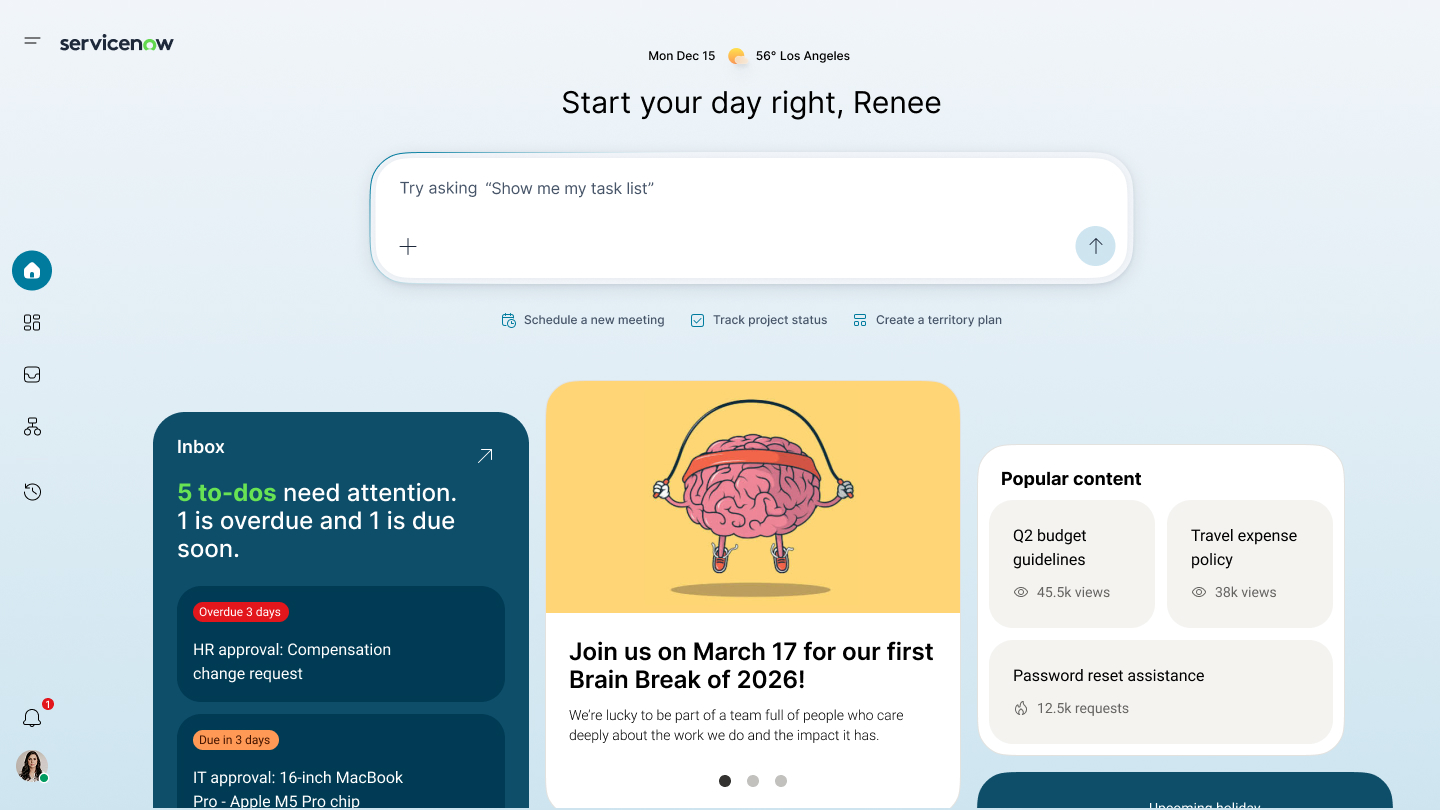
Employee Slate Home
Home

A role-aware starting point for priorities, pending actions, and AI-suggested next steps — contextual from the moment you arrive, no configuration needed.
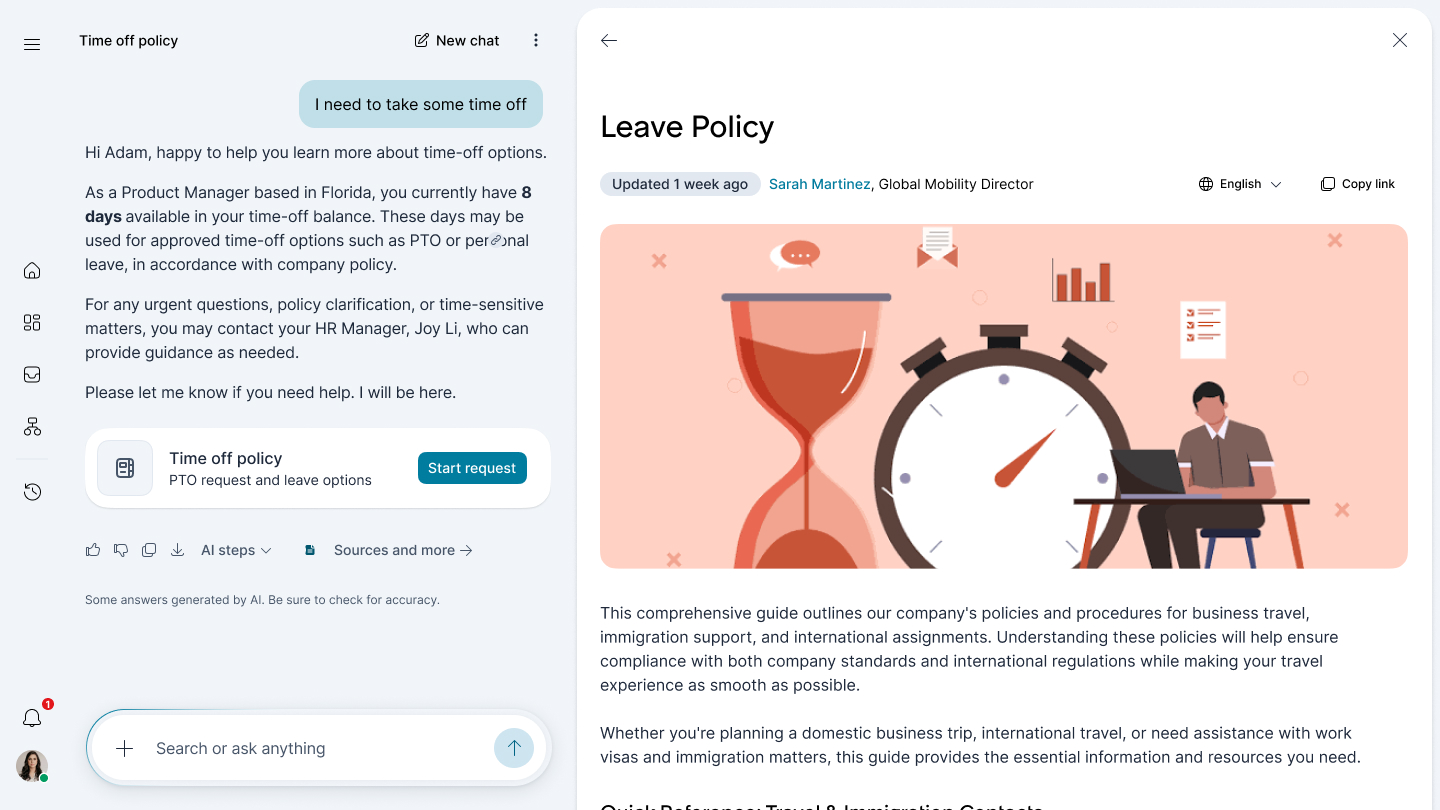
Employee Slate Split View
Conversation + Split View

When AI moves from understanding to action, conversation and execution stay connected. The employee sees why they're acting while completing what needs to be done.

Screenshots shown are selected views from the Employee Slate early-access build.

Impact

Concept to Early Access
in 4 months.

40%
Reduction in manual HR case volume
Employee Slate · Early Access Pilot
30%
Reduction in Tier-1 escalations
Employee Slate · Early Access Pilot
30%
Faster employee inquiry resolution
Employee Slate · Early Access Pilot
5+
Teams adopted the Agentic Action Pattern
Division-wide adoption

Impact figures are directional signals from the early-access cohort, not broad company-wide causal claims.

← Back to Selected Work Next Case Study →